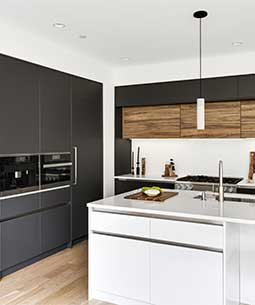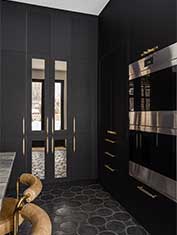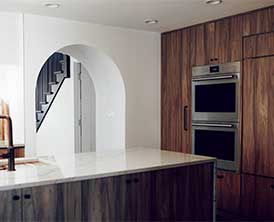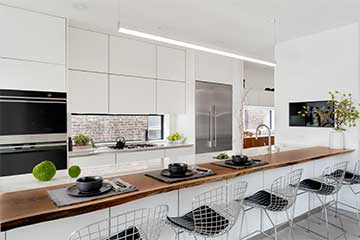

You've seen the number that stops people in their tracks.
"Custom cabinets start at $500 per linear foot."
And if you're like most homeowners, your first instinct is to close the browser tab and start googling "stock cabinets near me" instead.
We get it. That number — hanging out there with no context — sounds aggressive. But here's what nobody tells you about custom cabinet pricing:
The sticker price isn't the real cost. The real cost is what you pay per day to live in a kitchen that either works for you or doesn't.
A $15,000 set of custom cabinets that lasts 25 years costs you $1.64 per day. A $6,000 set of stock cabinets you replace in 8 years? That's $2.05 per day — plus the headache (and expense) of going through a kitchen remodel twice.
But we're getting ahead of ourselves. Let's break down exactly what custom kitchen cabinets cost in 2026, what drives those numbers, and where your money actually goes.
The Numbers: What Custom Cabinets Cost Right Now
Here's the straightforward pricing landscape for 2026:
| Cabinet Type | Cost Per Linear Foot (Installed) | Typical Kitchen (20 LF) |
|---|---|---|
| Stock / Ready-to-Assemble | $100 – $300 | $2,000 – $6,000 |
| Semi-Custom | $150 – $650 | $3,000 – $13,000 |
| Fully Custom | $500 – $1,200 | $10,000 – $24,000 |
That "per linear foot" measurement includes both upper and lower cabinets along the wall run. A standard 10×10 kitchen has roughly 20 linear feet of cabinetry.
For most homeowners investing in fully custom cabinets, the realistic range for a standard kitchen lands between $12,000 and $20,000 for the cabinets alone. Larger kitchens, complex layouts, or premium materials can push that number higher.
And here's an important detail: cabinets typically represent about 29% of a total kitchen remodel budget, according to the National Kitchen & Bath Association. So if your full remodel budget is $50,000, roughly $14,500 is going toward cabinetry — which lines up perfectly with the custom range.
The 7 Things That Actually Drive the Price
Custom cabinet pricing isn't arbitrary. Every dollar maps to a specific decision you're making. Here's what moves the needle:
1. Materials and Finish
This is the single biggest price variable. Your cabinet boxes can be built from engineered wood (like high-quality particle board with melamine interiors) or plywood — and both are legitimate choices depending on the application.
The real cost driver is the door and finish material:
- Thermofoil or melamine: Most affordable. Clean, consistent look.
- High-pressure laminate (HPL): Mid-range. Durable, huge color selection.
- FENIX nanotech surfaces: Premium. Self-healing, anti-fingerprint, matte luxury.
- Natural wood veneer: Premium. Unique grain patterns, real wood warmth.
- Lacquer/painted finishes: Premium. Flawless, custom-mixed colors.
Moving from a standard laminate to a FENIX or lacquer finish can add 20–40% to the cabinet cost — but the difference in look and feel is immediately obvious.
2. Cabinet Configuration and Complexity
A straight run of base and wall cabinets is the most cost-efficient layout. The price climbs when you add:
- Tall pantry units (more material, precision hardware)
- Corner solutions like blind corners, lazy Susans, or magic corners
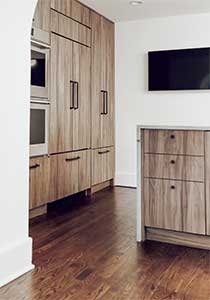
- Integrated appliance panels that wrap your dishwasher and refrigerator in matching cabinetry
- Custom island configurations with waterfall ends, seating overhangs, or mixed-depth sections
Every additional element requires engineering, precision cutting, and often specialty hardware. That's craftsmanship you're paying for — not markup.
3. Hardware Quality
This is where the difference between "budget custom" and "built to last" becomes tangible.
European-grade hardware from manufacturers like Blum and Hettich — the same brands used in German and Italian luxury kitchens — is tested to 200,000+ opening cycles. That's opening a drawer 15 times a day for 36 years.
Premium hardware includes:
- Soft-close hinges on every door
- Blum TANDEMBOX or LEGRABOX full-extension drawer systems
- AVENTOS lift systems for wall cabinets (bi-fold, stay-lift, or servo-drive)
- Push-to-open mechanisms for handleless designs
Quality hardware typically adds $800–$2,500 to a kitchen, depending on the number of doors, drawers, and lift systems. It's also the single best predictor of how your cabinets will feel five, ten, and twenty years from now.
4. Interior Accessories
This is where custom cabinets earn the "custom suit" comparison. Stock cabinets give you a box. Custom cabinets give you:
- Pull-out pantry systems with full-extension slides
- Drawer organizers custom-sized for your utensils, spices, and tools
- Built-in charging drawers with hidden USB outlets
- Under-sink organizers that work around plumbing
- Integrated trash and recycling pull-outs with soft-close
- Appliance garages that hide your coffee maker and toaster behind a retractable door
Each accessory adds $50–$500 depending on complexity, but these are the features that turn a kitchen from "nice cabinets" into "this kitchen was designed around my life."
5. Integrated Lighting
Modern custom cabinets can include built-in LED lighting — under-cabinet task lighting, in-drawer illumination, interior cabinet lighting, and even toe-kick ambient lighting. LED integration is engineered into the cabinet design, not stuck on afterward, which means cleaner lines and no visible wires.
Expect integrated lighting to add $500–$3,000 depending on how many zones you light up. It transforms the kitchen at night and adds real functionality to every workspace.
6. Exact Measurements vs. Standard Sizes
Stock cabinets come in 3-inch increments: 12", 15", 18", 21", and so on. If your wall is 127 inches, you get filler strips. Custom cabinets are built to the exact tenth of an inch.
That precision means:
- No filler pieces breaking the visual line
- No awkward gaps between the cabinet and the wall
- Maximum storage in every available inch
- Clean, seamless runs that look built-in — because they are
This precision adds cost in both design time and manufacturing, but it's arguably the most visible difference between stock and custom. Walk into two kitchens side by side and you'll spot it in three seconds.
7. Design Complexity
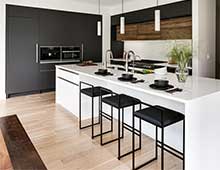
A simple, flat-panel kitchen in a single color with standard dimensions? That's the entry point of custom pricing. A kitchen with curved island ends, glass inserts, mixed materials, asymmetric layouts, and integrated appliance towers? That's the top of the range.
Design complexity isn't just about aesthetics — it's about engineering. Every curve, every mixed material junction, and every non-standard dimension requires additional design work, templating, and precision manufacturing.
Where Most People Overspend (and Where They Under-Invest)
After working with hundreds of homeowners, here's the pattern we see:
Common overspend areas:
- Upgrading every single door to the most expensive finish when a two-tone approach (premium on uppers or the island, standard on lowers) achieves the same visual impact for less
- Over-specifying pantry accessories in spaces that don't need them
- Choosing overly complex crown molding details that drive fabrication costs up without proportional visual return
Common under-investment areas:
- Hardware. This is not the place to save money. Cheap hinges and slides will be the first thing to degrade.
- Lighting. Integrated LEDs are 10x easier to add during manufacturing than to retrofit later.
- Drawer systems over door cabinets. Drawers cost more than doors but reclaim 30%+ of unusable space. Every kitchen designer will tell you: more drawers, fewer doors.
The Real Comparison: Cost Per Year
Here's the math that changes the conversation:
| Stock | Semi-Custom | Custom | |
|---|---|---|---|
| Upfront cost | $5,000 | $10,000 | $18,000 |
| Expected lifespan | 7–10 years | 12–15 years | 20–30+ years |
| Cost per year | $500–$714 | $667–$833 | $600–$900 |
| Includes one remodel | Yes (you'll redo them) | Maybe | No |
When you factor in the cost — and disruption — of remodeling your kitchen a second time (4–8 weeks of construction, eating out, living in dust), custom cabinets often end up being the same cost or less per year of use.
And that doesn't account for daily quality of life. The soft-close that never slams. The drawer that glides with one finger. The pantry that holds three times what a stock cabinet does. Those are the differences you experience 20 times a day, every day, for decades.
How to Get an Accurate Quote for Your Kitchen
Every kitchen is different — different layout, different finishes, different accessories — so published "average costs" can only take you so far. Here's how to get a real number for your specific project:
- Start with your layout. Know your approximate dimensions, or at least the room's footprint.
- Define your priorities. Are you most focused on a specific look? Maximum storage? Integrated technology? This helps the design team allocate budget where it matters most to you.
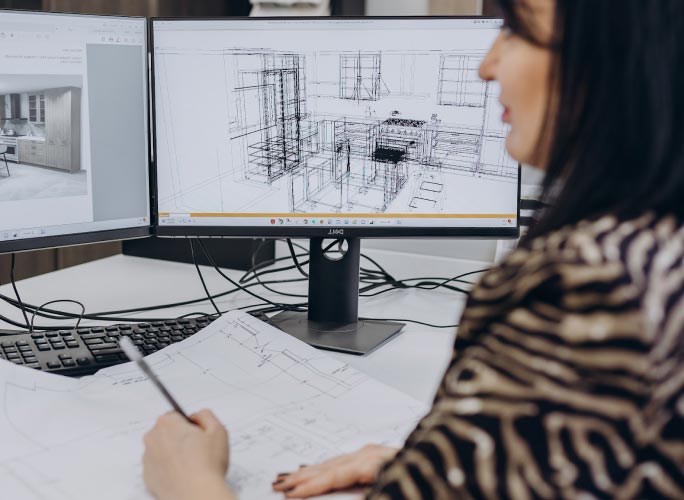
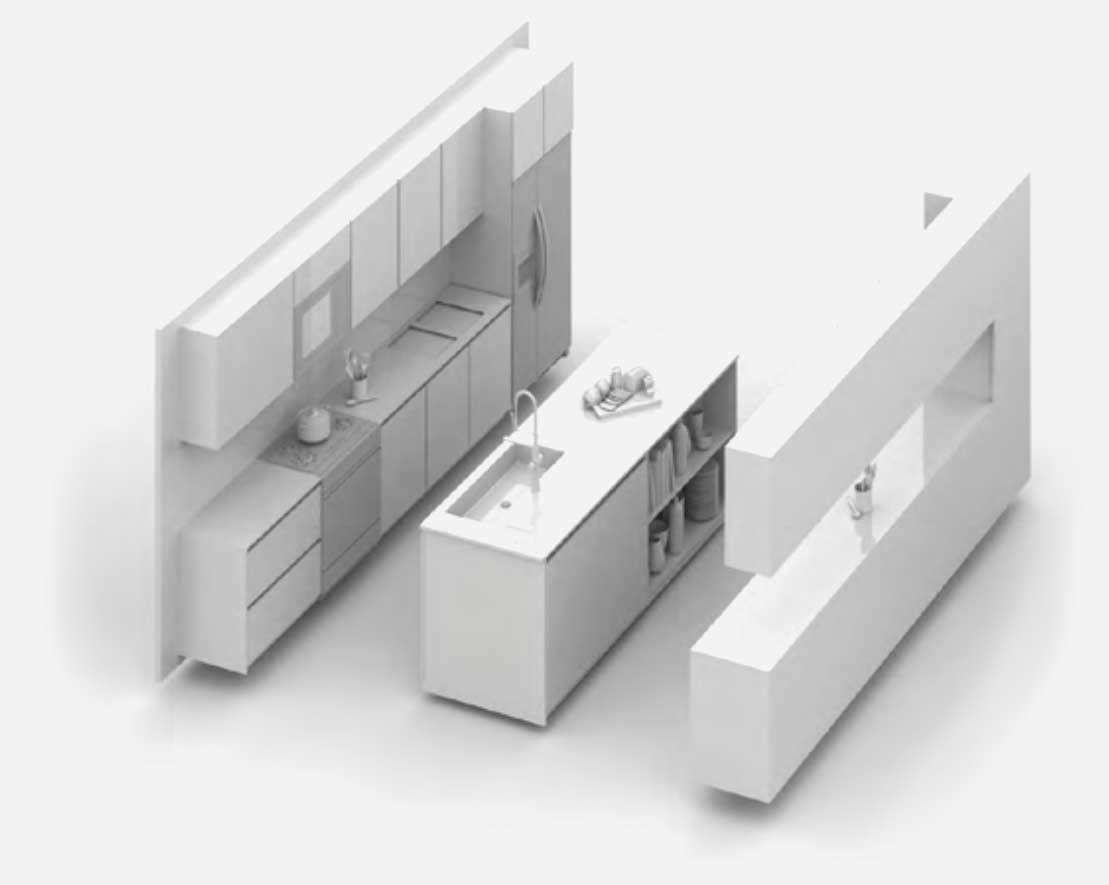
- Get a professional design. A 3D rendering lets you see exactly what you're getting — every cabinet, every accessory, every finish — before committing a dollar to production.
The fastest way to start? Take our quick design quiz — it takes about 2 minutes, and we'll follow up with a free initial design concept and pricing for your specific kitchen.
The Bottom Line
Custom cabinets aren't cheap. But "expensive" and "overpriced" are two very different things.
When you break down what you're actually getting — precision-built boxes engineered to your exact space, finished in your exact choice from 120+ options, fitted with hardware tested to outlast your mortgage, and designed around how you actually use your kitchen — the pricing makes sense.
The question isn't really "can I afford custom cabinets?"
The question is: "How much is it worth to get the kitchen right the first time?"